Launch · AI Assistants
Claude Haiku 5.5: Anthropic's cheapest, fastest small model, its price, benchmarks and what else changed
Claude Haiku 5.5 costs $0.10 and $0.50 per million tokens for prompts up to 100K, about 75% less than Haiku 4.5. See benchmarks and the Sonnet 5.5 price cut.

The short answer
Claude Haiku 5.5, released on October 7, 2026, is Anthropic's cheapest, fastest and most capable small model, built for high-volume, cost-sensitive work. For prompts up to 100,000 tokens it costs $0.10 per million input tokens and $0.50 per million output tokens, about 75% less to run than Haiku 4.5. Anthropic also halved Sonnet 5.5's cache-read price to $0.10 and added monthly API credits for Max and Team.
Claude Haiku 5.5 is the small model in Anthropic’s Claude 5.5 family, and it arrived on October 7, 2026, a little over a week after Claude Sonnet 5.5. Anthropic calls it “the cheapest, fastest, and most capable small model we’ve ever released”, and cuts the price sharply. This report covers the price, the benchmarks, the safeguards and the other changes announced alongside it, using Anthropic’s launch post and release notes. All benchmark figures are Anthropic’s own.
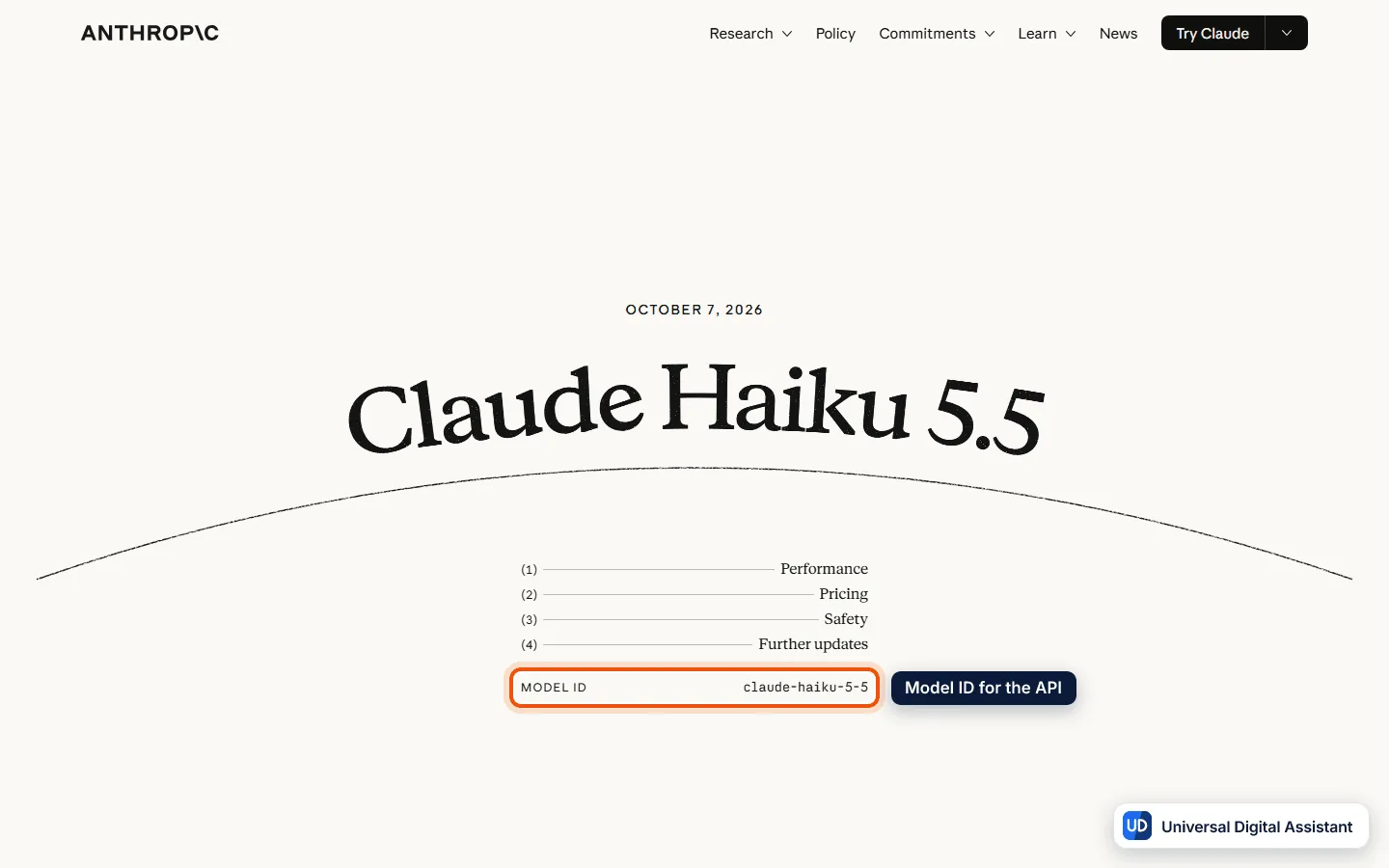
Screenshot: Anthropic’s Claude Haiku 5.5 announcement page. Captured by Universal Digital Assistant on October 17, 2026.
Claude Haiku 5.5 at a glance
| Detail | Claude Haiku 5.5 |
|---|---|
| Released | October 7, 2026 |
| Model ID | claude-haiku-5-5 |
| Input / output price per million tokens | $0.10 / $0.50 for prompts up to 100K; $0.50 / $2.50 above 100K |
| Versus Haiku 4.5 | Around 75% cheaper to run on average |
| Effort setting | Yes, a first for Haiku |
| Platforms | Claude Platform, Amazon Web Services, Google Cloud, Microsoft Azure |
| Best for | Summaries, classification, database queries, subagents, live support, browser use |
What it costs
Anthropic’s pricing table compares Haiku 5.5 with the model it replaces and with Sonnet 5.5:
| Price per 1M tokens | Haiku 5.5 (up to / over 100K prompt) | Haiku 4.5 | Sonnet 5.5 |
|---|---|---|---|
| Input | $0.10 / $0.50 | $1.00 | $2.00 |
| Output | $0.50 / $2.50 | $5.00 | $10.00 |
| Cache reads | $0.01 / $0.05 | $0.10 | $0.10 |
| Cache writes | $0.125 / $0.625 | $1.25 | $2.50 |
Anthropic says Haiku 5.5 is especially good value for prompts up to 100,000 tokens, which made up around 90% of requests to its previous Haiku. On average it costs about 75% less to run than Haiku 4.5.
What Anthropic says it is for
Haiku 5.5 “reliably handles quick and repetitive workloads”, such as summaries, compactions, database queries and classification, and pairs well with Opus 5.5 and Sonnet 5.5 as a subagent on coding work. As its fastest model, it also suits live customer support and browser use. Early-tester quotes in the post include:
- Asana: over a 30% reduction in latency and up to 2.5x faster inference per agent turn compared with the model it uses today.
- HubSpot: the best score it had seen from a smaller model on its CRM test suite, at 92.8%.
- Box: 11 points higher than Haiku 4.5 at about half the latency.
- Cognition: with Haiku 5.5 as a sidekick, its Devin Fusion holds a FrontierCode score of 66.2 while cutting cost and latency.
Benchmarks
| Benchmark (Anthropic-reported) | Haiku 5.5 | Haiku 4.5 | GPT-6 Luna | Sonnet 5.5 |
|---|---|---|---|---|
| GDPval-AA v2.1 (knowledge work) | 1620 | 735 | 1437 | 1840 |
| OSWorld 2.1 (computer use, offline subset) | 72.4% | 15.7% | 48.9% | 83.9% |
| Humanity’s Last Exam (with tools) | 57.4% | 18.7% | not reported | 64.5% |
| Terminal-Bench 4.0 (agentic coding) | 39.2% | 0.0% | 16.4% | 70.6% |
| FrontierCode 1.1 Main | 46.4% | not reported | 42.4% | 52.1% (Xhigh) |
The jump over Haiku 4.5 is large, and Haiku 5.5 beats OpenAI’s GPT-6 Luna on every test in this table that reports both. Anthropic is blunt about the limits, though: Sonnet 5.5 and Opus 5.5 “remain better choices for complex agentic coding tasks”, while Haiku 5.5 is best for narrowly scoped work that might otherwise have been too expensive.
Effort levels
Haiku 5.5 is the first Haiku-class model with an adjustable effort setting, so developers can choose between cost and intelligence. Anthropic’s charts show its OSWorld and Terminal-Bench results at Low, Medium, High, Xhigh and Max effort.
Safety and safeguards
Anthropic says Haiku 5.5 shows major improvements across almost all alignment evaluations relative to Haiku 4.5, with far fewer instances of misaligned behaviour and lower willingness to cooperate with misuse. Its cybersecurity safeguards are more restrictive than Haiku 4.5’s but somewhat less restrictive than those on other recent models. They allow a wider range of defensive tasks than Sonnet 5.5’s safeguards but still block penetration testing and other attacker techniques. Its biology safeguards match Sonnet 5, Sonnet 5.5 and Opus 5, and organisations can apply to the Life Sciences and Cyber Verification Programs.
Other changes announced with it
- Sonnet 5.5 is cheaper. Cache reads on Sonnet 5.5 now cost 50% less, $0.10 instead of $0.20 per million tokens, which Anthropic says lowers its cost on most agentic tasks by about 20%.
- Monthly API credits for Max and Team. Claude’s release notes say Max and Team plans now include a monthly credit for running your own apps and agents on the Claude Platform, rolling out over a few days. You claim it by linking a Claude Console organisation in billing settings.
Where it fits
Claude’s lineup is now Fable 5.1, Opus 5.5, Sonnet 5.5 and Haiku 5.5; see Claude models explained for which to use, and Claude Pro vs Max for the plans. For coding workflows, see how to use Claude Code, and for the assistant overall, the Claude profile. Rival small models include OpenAI’s GPT-6 Luna (see GPT-6 Sol and Luna) and Google’s Gemini 4 Argon at the top end.
Frequently asked questions
What is Claude Haiku 5.5?
Claude Haiku 5.5 is the third model in Anthropic's Claude 5.5 family, released on October 7, 2026. It is designed for high-volume, cost-sensitive tasks such as summaries, compactions, database queries and classification, and for subagent work and speed-sensitive jobs such as live customer support and browser use.
How much does Claude Haiku 5.5 cost?
For prompts up to 100,000 tokens it costs $0.10 per million input tokens and $0.50 per million output tokens. Above 100,000 tokens it costs $0.50 and $2.50. Cache reads are $0.01 or $0.05 per million. Anthropic says it costs around 75% less to run than Haiku 4.5, which cost $1 and $5.
Is Haiku 5.5 as good as Sonnet 5.5?
No. Anthropic says Sonnet 5.5 and Opus 5.5 remain better for complex agentic coding. Haiku 5.5 is best for narrowly scoped tasks, scoring 39.2% on Terminal-Bench 4.0 against Sonnet 5.5's 70.6%, but it is far cheaper and faster, and it improves sharply on Haiku 4.5.
What is Haiku 5.5's model ID?
The Claude Platform model ID is claude-haiku-5-5, and Anthropic says it is available now on all platforms, including Amazon Web Services, Google Cloud and Microsoft Azure. Anthropic has published a migration guide for developers coming from Haiku 4.5.
What else did Anthropic announce with Haiku 5.5?
It cut the cache-read price on Claude Sonnet 5.5 by 50%, from $0.20 to $0.10 per million tokens, which it says lowers Sonnet 5.5's cost on most agentic tasks by about 20%. It also added a monthly API credit for Claude Max and Team subscribers for building on the Claude Platform.
Does Haiku 5.5 have effort settings?
Yes. Anthropic says it is the first Haiku-class model with an adjustable effort setting, so you can trade cost against intelligence as you can with its other models. It shows results at Low, Medium, High, Xhigh and Max effort.
Sources
Product facts are checked against the vendor's own announcements and documentation.
- Introducing Claude Haiku 5.5 — Anthropichttps://www.anthropic.com/claude-haiku-5-5
- Claude release notes — Claude Help Centerhttps://support.claude.com/en/articles/12138966-release-notes


